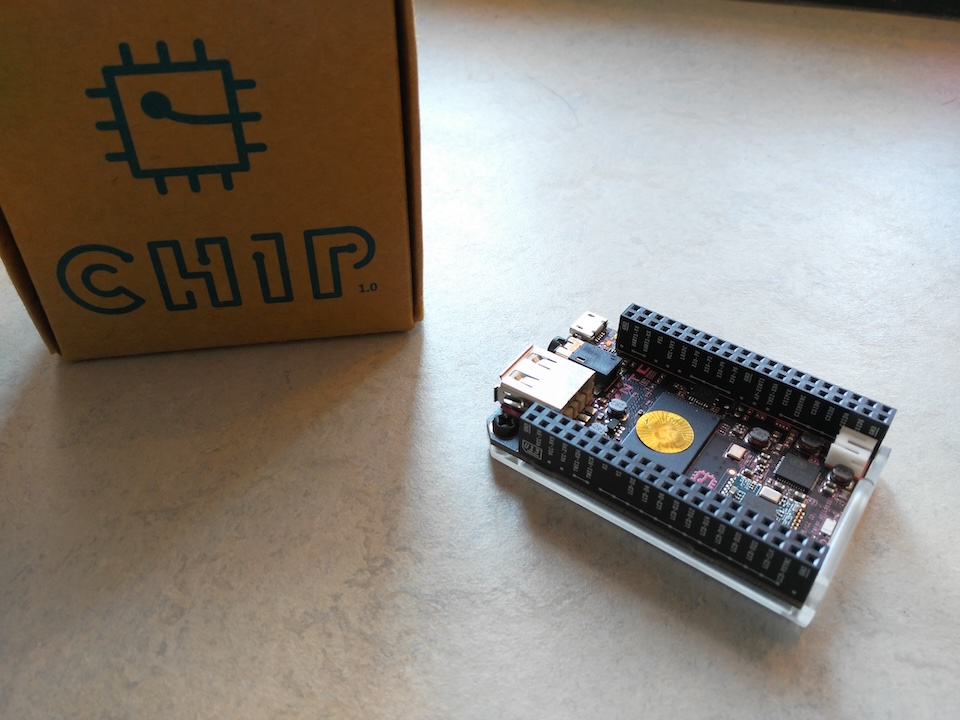
This is the C.H.I.P. I took this photo on July 25, 2016, when it first arrived at my college dorm room. It will turn 10 years old next month under my possession.
Trip down memory lane
The C.H.I.P. was (is?) a $9 computer built by Next Thing Co. (NTC from now on), a company that is now defunct. I recall the hype for the C.H.I.P. around the Twitter-verse (being on the radar for hobbyist hardware) at the time:
- World’s first $9 Linux computer
- $50,000 goal on Kickstarter; smashed by $1,000,000 funded (or so, at the time)
- 1 GHz CPU, 512 MB RAM, 4 GB eMMC storage
- Wi-Fi + Bluetooth connectivity
- Accessories on day 1
It was a legit stab at dethroning the Raspberry Pi Zero, the contemporary king of value SOCs at $5. NTC proved themselves and people welcomed the new kid on the block.
Take my money!
The Kickstarter pages were bustling with excited patrons. The FOMO got to me: I don’t remember exactly when I pulled the trigger, but it was past pre-orders IIRC. Took several months to be delivered but, boy, was I excited when it arrived!
The C.H.I.P. ran mainly headless as my web app test environment. Though, once in a while, I’d peek at the UI by connecting the C.H.I.P. to my dorm room TV via RCA. It has an XFCE (or something) as a Window Manager. Very lightweight, and understandably so, for such tight constraints.
Moving on
Throughout my Master’s, I passively followed NTC. They were planning some new products, some hardware along the lines of Apple CarPlay or Android Auto. I was rooting for them to release the next C.H.I.P. The Raspberry Pi must have a rival going forward.
Not long after starting my first research job at the university (after graduating), news broke that NTC went bust. Assets liquidated, backers unfulfilled, just up and left. It sucked, to put it plainly. I looked upon the C.H.I.P. with disenchantment, now orphaned. Now it gathers dust.
Onto 10 years later
Even early on, there was light at the horizon: a fringe cohort of enthusiasts that wanted to keep the C.H.I.P. alive (or perhaps memorialize it). They had backed up the docs, GitHub repos, web flasher, and re-hosted them.
The best one I found now (10 years later) is likely the JF Possibilities mirror site by an engineer from La Pine, Oregon. Yet another mirror is getchip.cc, though both sites probably have stale content from 2018. There are a swath of wiki pages from after-market OSes (postmarketOS, sunxi-linux) for users who want something newer that might work. Also many community GitHub pages for extra support.
A while later (likely during COVID times), I played around with the C.H.I.P., reviving it just to test the community tools, and eventually flashed a stock ROM before putting it back to sleep.
10 years later
Earlier this year, while doing some major spring cleaning, the C.H.I.P. revealed itself yet again. I had moved a couple of times at least, probably exposed it to the extreme heat while doing so, kept it in a random storage condition exposed to static electricity, basically not giving it much TLC.
I plugged the C.H.I.P in and it lit up: the still purple light and blinking white light! But was it working? How could I tell? I no longer had a TV that had an RCA port. Fortunately, my memory recalled the USB-to-serial feature. I connected it to my Raspberry Pi 5 via a USB cable and invoked
syafiq@pi:~$ screen /dev/ttyUSB0 115200

Debian GNU/Linux 8 chip ttyGS0

chip login:
A prompt appeared! There was no way. Is this real? I logged in with chip/chip (default credentials) and there it was:
Linux chip 4.4.13-ntc-mlc #1 SMP Tue Dec 6 21:38:00 UTC 2016 armv7l

The programs included with the Debian GNU/Linux system are free software;
the exact distribution terms for each program are described in the
individual files in /usr/share/doc/*/copyright.

Debian GNU/Linux comes with ABSOLUTELY NO WARRANTY, to the extent
permitted by applicable law.
chip@chip:~$
It’s ALIVE! I checked the Wi-Fi connection with nmtui. It was looking for a Wi-Fi SSID that was familiar. When did I even last log in?
chip@chip:~$ last -F
chip     pts/0        192.168.68.55    Wed Feb 25 14:25:39 2026   still logged in
chip     ttyGS0                        Wed Feb 25 14:25:07 2026 - Wed Feb 25 14:25:17 2026  (00:00)
chip     ttyGS0                        Thu Jan  1 00:17:41 1970 - Wed Feb 25 14:23:58 2026 (20509+14:06
chip     ttyGS0                        Thu Jan  1 00:04:27 1970 - Thu Jan  1 00:16:39 1970  (00:12)
reboot   system boot  4.4.13-ntc-mlc   Thu Jan  1 00:00:12 1970 - Wed Feb 25 20:21:26 2026 (20509+20:21
chip     pts/0        192.168.0.111    Fri Jan 22 10:07:02 2021 - Fri Jan 22 10:37:37 2021  (00:30)
chip     pts/0        192.168.0.111    Tue Jan 19 16:20:25 2021 - Tue Jan 19 16:21:28 2021  (00:01)
chip     pts/0        192.168.0.111    Tue Jan 19 03:19:03 2021 - Tue Jan 19 05:51:19 2021  (02:32)
reboot   system boot  4.4.13-ntc-mlc   Thu Jan  1 00:00:11 1970 - Wed Feb 25 20:21:26 2026 (20509+20:21
chip     pts/0        192.168.0.111    Mon Jan 18 19:57:42 2021 - Mon Jan 18 20:23:40 2021  (00:25)
chip     pts/0        192.168.0.111    Mon Jan 18 19:57:08 2021 - Mon Jan 18 19:57:22 2021  (00:00)
chip     pts/0        192.168.0.111    Mon Jan 18 19:56:33 2021 - Mon Jan 18 19:56:48 2021  (00:00)
chip     ttyGS0                        Thu Jan  1 00:07:26 1970 - Mon Jan 18 19:56:08 2021 (18645+19:48
chip     ttyGS0                        Thu Jan  1 00:06:26 1970 - Thu Jan  1 00:06:28 1970  (00:00)
reboot   system boot  4.4.13-ntc-mlc   Thu Jan  1 00:00:11 1970 - Mon Jan 18 20:23:41 2021 (18645+20:23
5 years ago — that was the time I last logged in. Yes, this post is a few months late. But, the 4.4.13-ntc-mlc is most interesting: it says that the kernel is version 4.4.13. Let’s dive deep:
chip@chip:~$ uname -a
Linux chip 4.4.13-ntc-mlc #1 SMP Tue Dec 6 21:38:00 UTC 2016 armv7l GNU/Linux
chip@chip:~$ cat /etc/os-release
PRETTY_NAME="Debian GNU/Linux 8 (jessie)"
NAME="Debian GNU/Linux"
VERSION_ID="8"
VERSION="8 (jessie)"
ID=debian
HOME_URL="http://www.debian.org/"
SUPPORT_URL="http://www.debian.org/support"
BUG_REPORT_URL="https://bugs.debian.org/"
  BUILD_ID=Fri Dec  9 22:09:06 UTC 2016
  VARIANT="Debian on C.H.I.P"
  VARIANT_ID=SERVER
It looks like the Linux version that I flashed 5 years ago is the same Linux image that was built at the time of the C.H.I.P.’s release. It’s running Debian 8 (Jessie) which is 5 versions behind the current one (13, Trixie). This is long EOL.
chip@chip:~$ cat /proc/cpuinfo
processor     : 0
model name    : ARMv7 Processor rev 2 (v7l)
BogoMIPS      : 429.72
Features      : half thumb fastmult vfp edsp thumbee neon vfpv3 tls vfpd32
CPU implementer       : 0x41
CPU architecture: 7
CPU variant   : 0x3
CPU part      : 0xc08
CPU revision  : 2
Hardware      : Allwinner sun4i/sun5i Families
Revision      : 0000
Serial                : 162542180e0237a8
chip@chip:~$ cat /proc/version
Linux version 4.4.13-ntc-mlc (bamboo@ip-172-31-21-118) (gcc version 5.2.1 20151010 (Ubuntu 5.2.1-22ubuntu1) ) #1 SMP Tue Dec 6 21:38:00 UTC 2016
Single-core CPU, what a time to be alive. This is definitely not running any LLMs (though you can run one on a Raspberry Pi 5). The kicker is the gcc from 2015. At this point, this is digital archeology. Makes me feel old.
Resilience
The C.H.I.P. outlived the company that made it. Now it belongs to a little community that cherishes it however they will. It also stood the test of time under my care; but I know these embedded systems have their priorities set straight: they’re meant to just wake up one day and get back to work — ready at a moment’s notice.
I might just test some vulnerabilities with this system. Old Linux are rife with exploitable programs. I will unleash Claude on this poor thing. Not before I back it up, of course.
See you in 10 years, C.H.I.P.
A quiet renaissance?
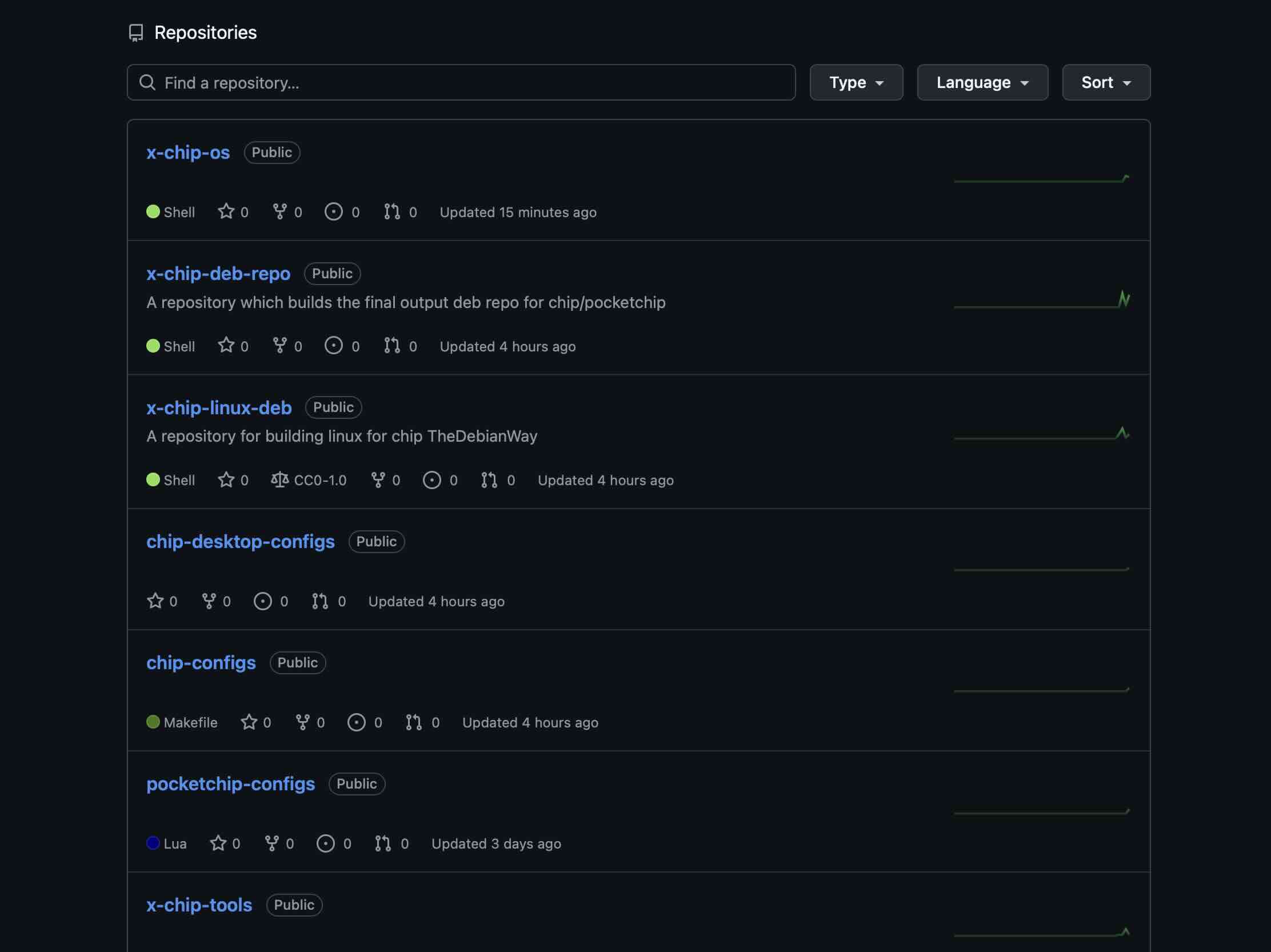
While I was writing this, I browsed NTC’s GitHub page and there seems to be some hints of life. In fact, there are lots of activity in early June 2026. Possibly the team members dumping source code to GitHub?
The reason I’m saying this: the last update to these repos is around 12 years ago. Worth keeping an eye out for what’s coming 👀. This is what I captured on June 23, 2026 around 07:00.